
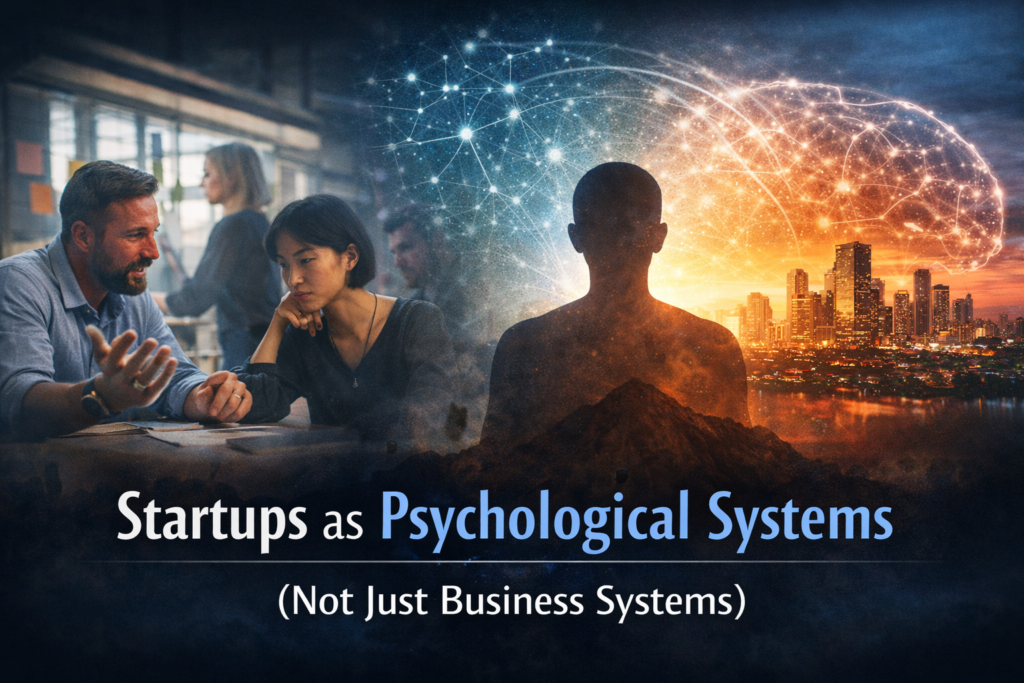
Why Most Startup Thinking Is Incomplete
Traditional startup frameworks describe companies as:
- Products
- Processes
- Teams
- Markets
People are treated as resources—units of execution that can be optimized, scaled, or replaced.
This model misses a fundamental truth:
A startup is not only a business system.
It is a psychological system under extreme compression.
At MESMA Lab, startups are studied not merely as economic entities, but as living mental ecosystems—where cognition, emotion, fear, ambition, and identity interact continuously.
The Reality of Early-Stage Startups: Psychological Compression
In large organizations, psychological stress is distributed.
In startups, it is concentrated.
Early-stage companies exhibit three defining conditions:
1. Decision-Making Is Highly Concentrated
A small number of individuals—often one founder—carry:
- Strategic decisions
- Financial risk
- Vision clarity
- Moral responsibility
This concentration means inner instability cannot hide.
It immediately leaks into execution.
2. Emotional Contagion Is Rapid
In startups:
- A founder’s anxiety becomes team urgency
- A leader’s doubt becomes collective hesitation
- A moment of panic reshapes weeks of work
Emotions do not stay private.
They propagate silently through tone, timing, and behavior.
3. Founder Psychology Becomes Organizational Psychology
Before culture decks and values statements exist, something else forms first:
The emotional climate of the founder becomes the emotional climate of the company.
This happens unconsciously—and early.
Startups as Compressed Human Systems
MESMA reframes startups as compressed human systems, where small inner disturbances scale disproportionately.
Within these systems:
- One unresolved fear multiplies across teams
Fear of failure, loss of control, or inadequacy quietly shapes decision-making, risk tolerance, and communication. - One dysregulated leader destabilizes execution
Not through incompetence, but through inconsistency—shifting priorities, emotional reactivity, or withdrawal under pressure. - One unspoken emotional pattern shapes culture silently
Avoidance becomes “politeness.”
Overwork becomes “commitment.”
Silence becomes “alignment.”
No one formally decides these patterns.
They emerge organically—and then harden.
Why Scaling Without Awareness Scales Fragility
When startups scale without examining their inner structures, they unintentionally scale:
- Anxiety
- Emotional suppression
- Reactivity
- Burnout dynamics
The visible systems grow:
- Teams
- Revenue
- Infrastructure
But the invisible systems—how people think, feel, and respond under stress—remain unexamined.
This is why some startups collapse suddenly despite strong metrics.
The fault line existed long before the break.
The Shift MESMA Introduces
MESMA does not reject growth.
It reframes the core question behind it.
From:
“How do we scale fast?”
To:
“What inner structures are we scaling?”
This single shift changes everything:
- Leadership becomes self-aware before it becomes authoritative
- Culture is observed before it is formalized
- Psychological risk is addressed early, not post-burnout
Why This Perspective Matters Now
The startup ecosystem is no longer just fast—it is emotionally demanding at unprecedented levels.
Founders today face:
- Continuous visibility
- Permanent uncertainty
- Identity entanglement with their companies
Ignoring the psychological dimension is no longer neutral.
It is a hidden liability.
MESMA’s contribution lies in making the invisible visible, early enough to matter.
To Infer
Every startup scales something.
The only question is whether it is scaling:
- Awareness or avoidance
- Coherence or chaos
- Resilience or fragility
Startups are not just built.
They are felt, absorbed, and lived—first by their founders, and then by everyone who joins them.